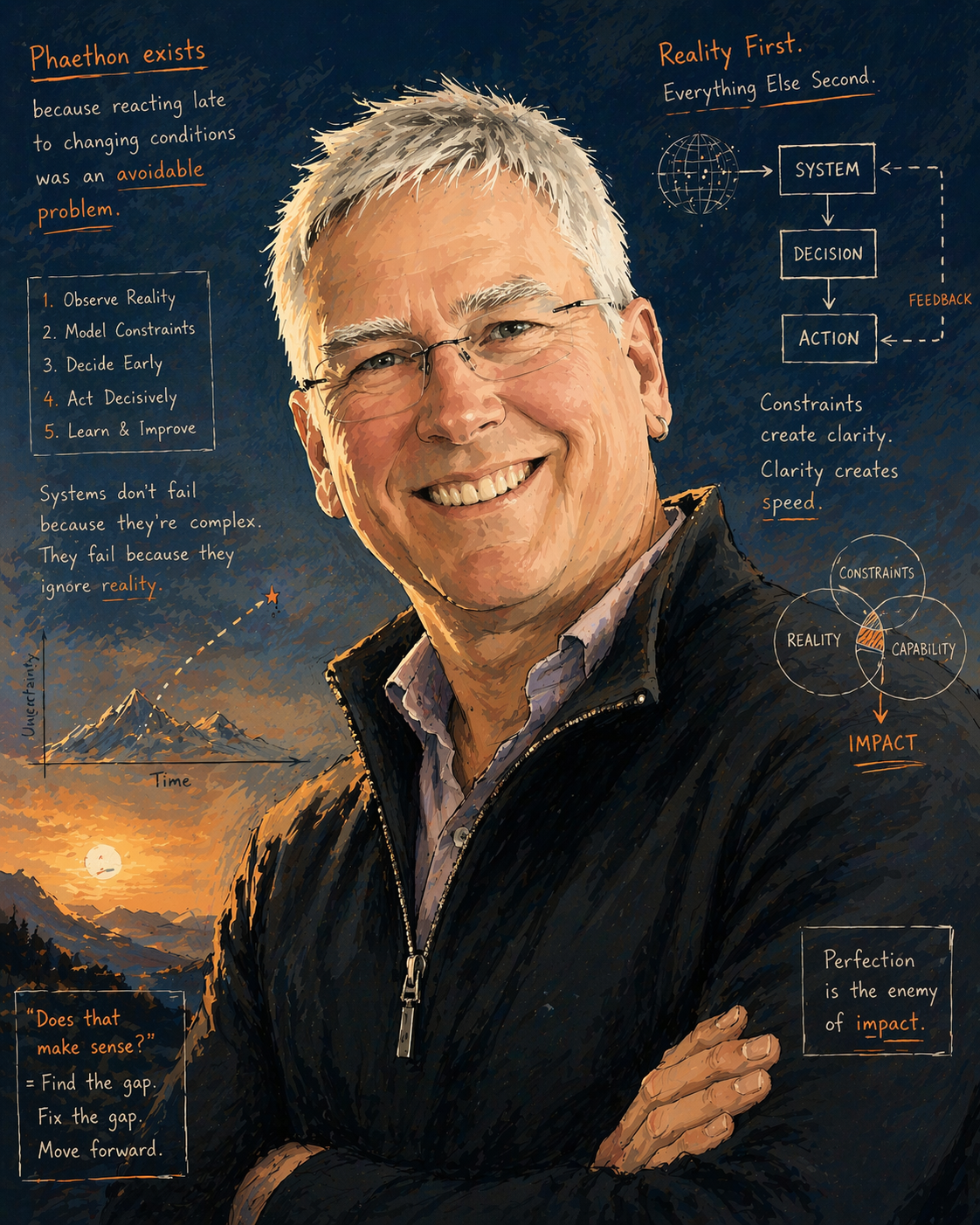
Tim "Skyhook" Beauchamp
//skyhook
CEO / Founder / Chief Executive of Fun
Tim is the one who insists the system answer to reality, not the other way around.
He has spent years building distributed systems at scale, which is how he developed a low tolerance for anything that works "most of the time." Phaethon exists because he decided that reacting late to changing conditions was an avoidable problem.
He sets direction, makes the final call when tradeoffs get uncomfortable, and has a habit of asking simple questions that expose complicated gaps.
When Tim asks, "does that make sense?" he is not asking for reassurance.
Specialty: turning real-world constraints into engineering requirements.
Clarke "Groundwire" Mercer
//groundwire
Infrastructure & Operations
Clarke owns the part of the system that has to work every time.
He is responsible for the movement, integrity, and availability of data across environments that do not naturally cooperate. If something fails silently, Clarke treats that as a design flaw, not bad luck.
He prefers systems that are observable, repeatable, and documented well enough that someone else can fix them at an inconvenient hour. He trusts logs more than assumptions and has little patience for anything that cannot be explained after the fact.
Most failures, in his experience, are not surprising. They were simply not made visible early enough.
Working principle: if it isn't reliable, it isn't done.

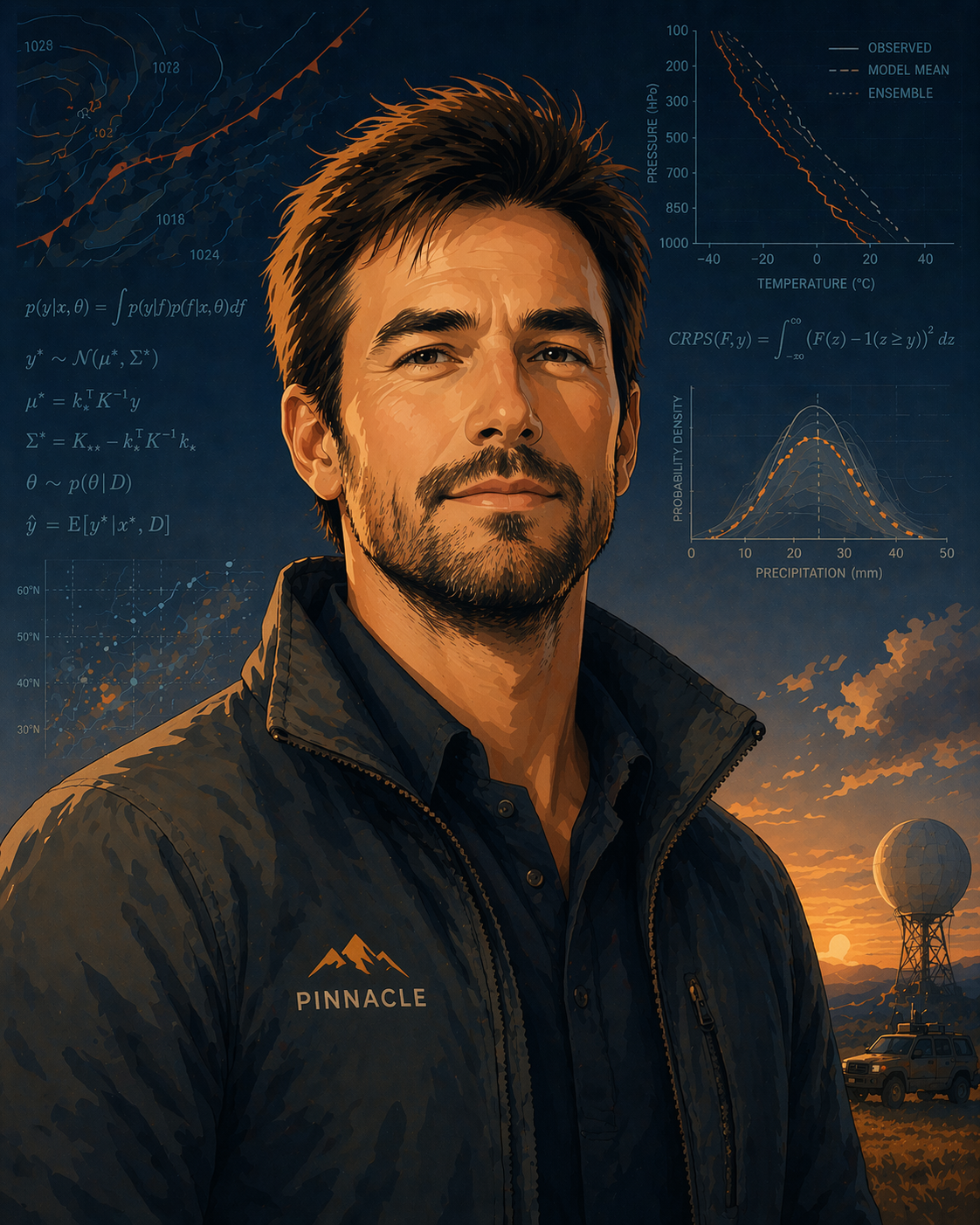
Curi "Vector" Lin
//vector
Intelligence & Analysis
Curi works on the part of the system that has to make a decision before all the information is available.
She started in statistical software — large Bayesian models, carefully constructed assumptions, results that had to be explained, not just observed. That background still shows in how she approaches problems.
Her focus is not just correctness, but timing. A perfect answer delivered too late is indistinguishable from a wrong one.
She is comfortable with uncertainty, provided it can be measured, bounded, and improved. A model that can explain itself is always preferred over one that simply performs.
Working principle: better a rough answer early than a perfect answer late — provided you can prove it improves.
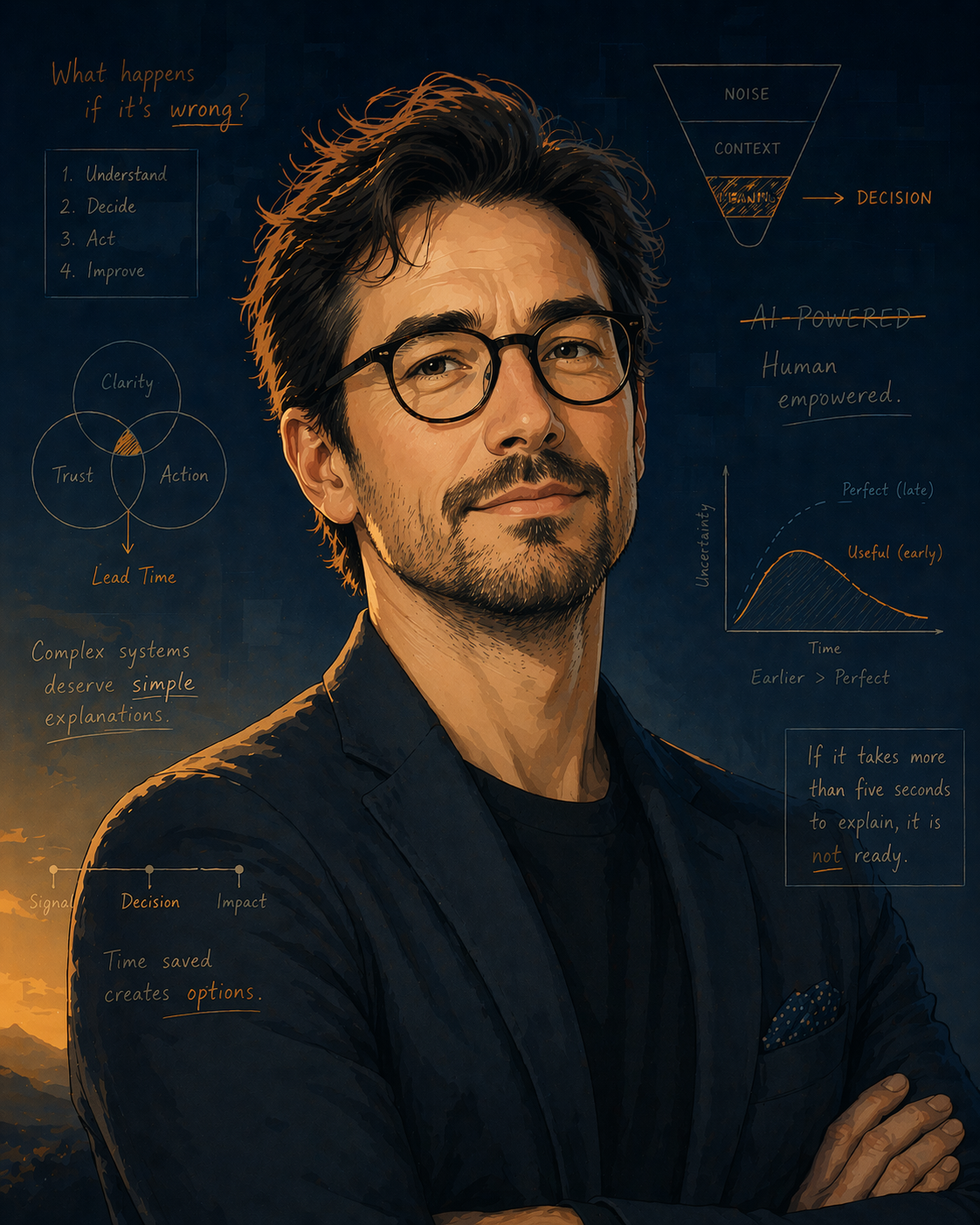
Henry "Helios Minor" Vale
//helios-minor
Head of Marketing
Henry joined after the system started working. His role is to make sure it can be understood just as quickly.
He believes most technical products fail not because they do not work, but because they take too long to explain. His job is to remove anything that sounds impressive but does not help someone make a decision.
He does not ask what the system does. He asks what happens if it is wrong.
Henry dislikes the phrase "AI-powered." He will delete it on sight.
He is called "Helios Minor" because he does not control the system. He just makes sure you are not surprised by it.
Working principle: if it takes more than five seconds to explain, it is not ready.
The System
Phaethon
Phaethon is an observation project for conditions that change before most people notice they have changed.
It is less interested in spectacle than in timing, less interested in exhaustive explanation than in seeing enough soon enough.
Its value is measured in reduced surprise, sharper posture, and the quiet advantage of noticing a pattern early.
Named for the son of Helios who lost control of the sun chariot — and scorched the earth until Zeus intervened.
Phaethon exists for the moment before loss of control becomes visible to everyone else.